

| CAD Model: | View CAD Model |
| Pkg. Type: | QFN |
| Pkg. Code: | LJQ |
| Lead Count (#): | 32 |
| Pkg. Dimensions (mm): | 5.0 x 5.0 x 0.90 |
| Pitch (mm): | 0.5 |
| Moisture Sensitivity Level (MSL) | 3 |
| Pb (Lead) Free | Yes |
| ECCN (US) | EAR99 |
| HTS (US) | 8542.39.0090 |
| RoHS (ISL8120IRZ-TK) | Download |
| Lead Count (#) | 32 |
| Carrier Type | Reel |
| Moisture Sensitivity Level (MSL) | 3 |
| Pb (Lead) Free | Yes |
| Pb Free Category | Pb-Free 100% Matte Tin Plate w/Anneal-e3 |
| Temp. Range (°C) | -40 to +85°C |
| Bias Voltage Range (V) | 3 - 5.6 |
| Droop | Yes |
| Input Voltage (Max) (V) | 22 |
| Input Voltage (Min) (V) | 2.97 |
| Integrated MOSFET Driver (s) | Yes |
| Length (mm) | 5 |
| MOQ | 3000 |
| Output Current (Max) [Rail 1] (A) | 60 |
| Output Voltage (Max) (V) | 19.8 |
| Output Voltage (Min) (V) | 0.6 |
| Outputs (Max) (#) | 2 |
| Parametric Applications | Scale for 1-, 2-, 3-, 4-, 6-, up to 12- Phase with Single Output |
| Parametric Category | Multiphase DC/DC Switching Controllers |
| Phases (Max) | 2 |
| Pitch (mm) | 0.5 |
| Pkg. Dimensions (mm) | 5.0 x 5.0 x 0.90 |
| Pkg. Type | QFN |
| Qualification Level | Standard |
| Thickness (mm) | 0.9 |
| VID | No VID |
| Width (mm) | 5 |
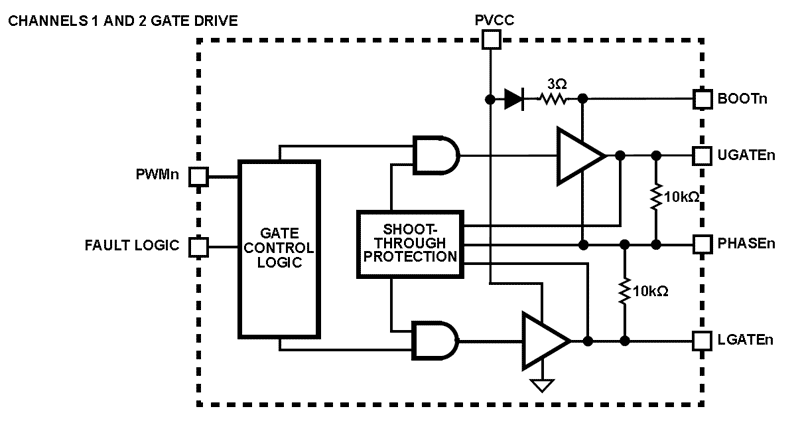
The ISL8120 integrates two voltage-mode PWM leading-edge modulation control, with input feed-forward synchronous buck PWM controllers, to control a dual independent voltage regulator or a 2-phase single output regulator. It also integrates current sharing control for the power module to operate in parallel, which offers high system flexibility. The ISL8120 integrates an internal linear regulator, which generates VCC from input rail for applications with only one single supply rail. The internal oscillator is adjustable from 150kHz to 1. 5MHz, and is able to synchronize to an external clock signal for frequency synchronization and phase paralleling applications. Its PLL circuit can output a phase-shift programmable clock signal for the system to be expanded to 3-, 4-, 6-, 12- phases with desired interleaving phase shift. The ISL8120’s Fault Hand Shake feature protects any channel from overloading/stressing due to system faults or phase failure. The undervoltage fault protection features are also designed to prevent a negative transient on the output voltage during falling down. This eliminates the Schottky diode that is used in some systems for protecting the load device from reversed output voltage damage.