
Package Information
| CAD Model: | View CAD Model |
| Pkg. Type: | QSOP |
| Pkg. Code: | MLK |
| Lead Count (#): | 16 |
| Pkg. Dimensions (mm): | 4.9 x 3.9 x 1.47 |
| Pitch (mm): | 0.6 |
Environmental & Export Classifications
| Moisture Sensitivity Level (MSL) | 2 |
| Pb (Lead) Free | Yes |
| ECCN (US) | EAR99 |
| HTS (US) | 8542.39.0090 |
| RoHS (ISL6753AAZA) | Download |
Product Attributes
| Pkg. Type | QSOP |
| Lead Count (#) | 16 |
| Carrier Type | Tube |
| Moisture Sensitivity Level (MSL) | 2 |
| Pb (Lead) Free | Yes |
| Pb Free Category | Pb-Free 100% Matte Tin Plate w/Anneal-e3 |
| Temp. Range (°C) | -40 to +105°C |
| Control Mode | Voltage, Peak Current, or Average Current Mode |
| Duty Cycle (%) | 99 - 99 |
| FET Driver Output Current (Max) (A) | 0.01 |
| Length (mm) | 4.9 |
| MOQ | 980 |
| No-Load Operating Current | 11 mA (typ), 15.5 mA (max) |
| PWMs (#) | 4 |
| Parametric Category | Zero Voltage Switching (ZVS) Full Bridge Controllers |
| Pitch (mm) | 0.6 |
| Pkg. Dimensions (mm) | 4.9 x 3.9 x 1.47 |
| Qualification Level | Standard |
| Simulation Model Available | iSim |
| Switching Frequency (KHz) | 2000 - 2000 |
| Thickness (mm) | 1.47 |
| Topology Characteristic | Full-Bridge ZVS |
| Topology [Rail 1] | Zero-Voltage-Switching (ZVS) |
| UVLO Falling (V) | 7 |
| UVLO Rising (V) | 8.75 |
| VBIAS (Max) (V) | 20 |
| Width (mm) | 3.9 |
Resources for ISL6753
Description
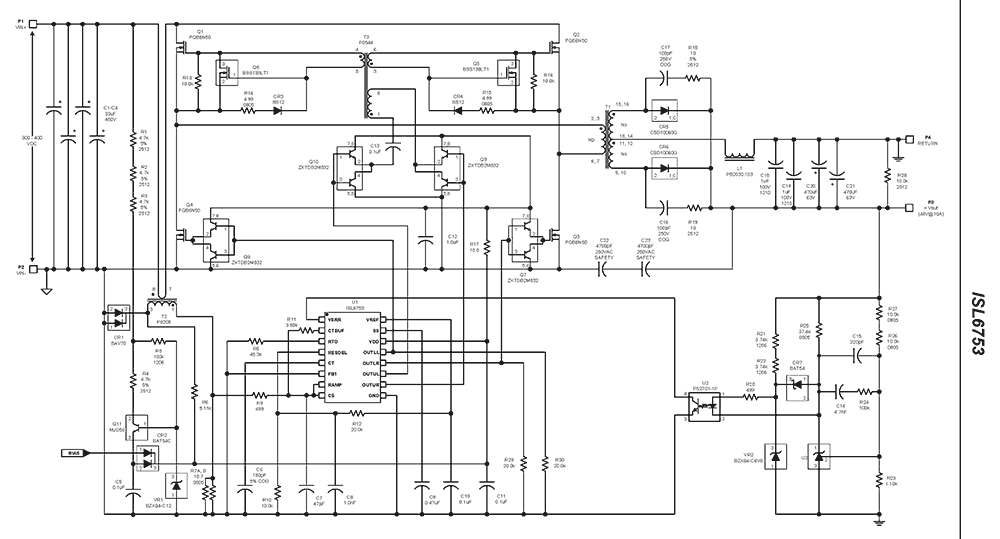
The ISL6753 is a high-performance, low-pin-count alternative, zero-voltage switching (ZVS) full-bridge PWM controller. Like the ISL6551, it achieves ZVS operation by driving the upper bridge FETs at a fixed 50% duty cycle while the lower bridge FETS are trailing-edge modulated with adjustable resonant switching delays. Compared to the more familiar phase-shifted control method, this algorithm offers equivalent efficiency and improved overcurrent and lightload performance with less complexity in a lower pin count package. This advanced BiCMOS design features low operating current, adjustable oscillator frequency up to 2MHz, adjustable soft-start, internal over temperature protection, precision deadtime and resonant delay control, and short propagation delays. Additionally, Multi-Pulse Suppression ensures alternating output pulses at low duty cycles where pulse skipping may occur.