
Package Information
| CAD Model: | View CAD Model |
| Pkg. Type: | QFN |
| Pkg. Code: | LGV |
| Lead Count (#): | 24 |
| Pkg. Dimensions (mm): | 4.0 x 4.0 x 0.90 |
| Pitch (mm): | 0.5 |
Environmental & Export Classifications
| Moisture Sensitivity Level (MSL) | |
| Pb (Lead) Free | No |
| ECCN (US) | |
| HTS (US) |
Product Attributes
| Lead Count (#) | 24 |
| Carrier Type | Reel |
| Pb (Lead) Free | No |
| Temp. Range (°C) | -40 to +85°C |
| Adjustable POR Timeout | No |
| Adjustable Vtrip | Yes |
| Advanced Features | PGOOD, Individual Reset Outputs, UV/OV Monitor |
| Fixed Vtrip | No |
| Input Voltage (Max) (V) | 5.5 |
| Input Voltage (Min) (V) | 1.5 |
| Interface | N/A |
| Length (mm) | 4 |
| MOQ | 6000 |
| Manual Reset | Yes |
| Monitor Voltage (Max) (V) | 5.5 - 5.5 |
| Parametric Category | Voltage Supervisor & Reset ICs |
| Pitch (mm) | 0.5 |
| Pkg. Dimensions (mm) | 4.0 x 4.0 x 0.90 |
| Pkg. Type | QFN |
| Qualification Level | Standard |
| Reset Output Type | Active Low |
| Thickness (mm) | 0.9 |
| TwinPin™ MR#/RST# | No |
| VMONITOR | Adj to 0.7V Ref |
| Voltage Monitors (#) | 4 |
| WDT | No |
| Width (mm) | 4 |
Resources for ISL6132
Description
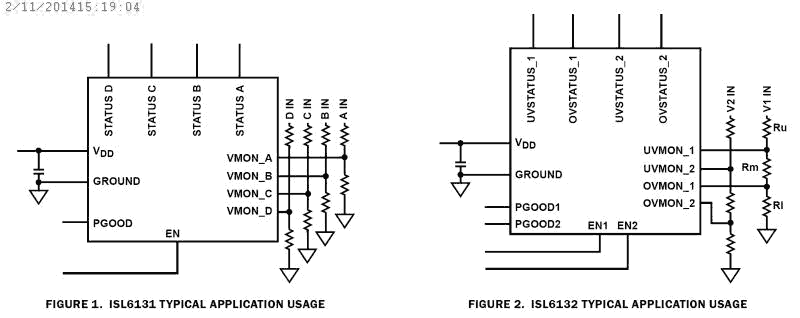
The ISL6131 and ISL6132 are a family of high-accuracy, multi-voltage supervisory ICs designed to monitor voltages greater than 0. 7V in applications ranging from microprocessors to industrial power systems. The ISL6131 is an undervoltage four-supply supervisor, and the ISL6132 is a two-voltage supervisor monitoring for undervoltage (UV) and overvoltage (OV) conditions. Both ICs feature four external resistor programmable voltage monitoring (VMON) inputs, each with a related STATUS output that individually reports the related monitor input condition. In addition, there is a Power-Good (PGOOD) signal that asserts high when the STATUS outputs are in their correct state. A stability delay of approximately 160ms ensures that the monitored supply is stable before STATUS and PGOOD are released to go high. The PGOOD and STATUS outputs are open-drain to allow OR’ing of the signals and interfacing to a wide range of logic levels. STATUS and PGOOD outputs are guaranteed to be valid with IC bias lower than 1V, eliminating concern about STATUS and PGOOD outputs during IC bias up and down. VMON inputs are designed to ignore momentary transients on the monitored supplies.