
Package Information
| CAD Model: | View CAD Model |
| Pkg. Type: | WLCSP |
| Pkg. Code: | |
| Lead Count (#): | 12 |
| Pkg. Dimensions (mm): | 1.65 mm x 1.25 mm, 12-pin WLCSP |
| Pitch (mm): | 0.4 |
Environmental & Export Classifications
| Moisture Sensitivity Level (MSL) | 1 |
| Pb (Lead) Free | Yes |
| ECCN (US) | EAR99 |
| HTS (US) | 8542.39.0090 |
Product Attributes
| Lead Count (#) | 12 |
| Carrier Type | Tape & Reel |
| Moisture Sensitivity Level (MSL) | 1 |
| Pb (Lead) Free | Yes |
| Battery Interface | No |
| Bus Voltage (Max) (V) | 5.5 |
| Control Type | I2C, DVC |
| Function | 2-ch PMIC |
| GPIOs (#) | 1 |
| IQ [Rail 1] (µA) | 1.35 |
| Input Voltage (Max) (V) | 5.5 |
| Input Voltage (Max) [Rail 1] | 5.5 |
| Input Voltage (Min) (V) | 2.5 |
| Input Voltage (Min) [Rail 1] (V) | 2.5 |
| Input Voltage Range (V) | 2.5 - 5.5 |
| Integrated Battery Charger | No |
| Integrated step-down DC/DC Converter Channels (#) | 1 |
| LDOs | 1 |
| Linear Output | Yes |
| MOQ | 4500 |
| Output Current (Max) [Rail 1] (A) | 0.3 |
| Output Current Max (A) | 0.3 |
| Output Voltage (Max) (V) | 1.9 |
| Output Voltage (Max) [Rail 1] (V) | 1.9 |
| Output Voltage (Min) (V) | 0.6 |
| Output Voltage (Min) [Rail 1] (V) | 0.6 |
| Output Voltage Range (V) | 0.6 - 1.9 |
| Outputs (#) | 2 |
| Parametric Category | Multi-Channel Power Management ICs (PMICs) |
| Peak Efficiency (%) | 81 |
| Pitch (mm) | 0.4 |
| Pkg. Dimensions (mm) | 1.65 mm x 1.25 mm, 12-pin WLCSP |
| Pkg. Type | WLCSP |
| Qty. per Reel (#) | 4500 |
| Qualification Level | Standard |
| Step-up DC/DC converter Channels (#) | 0 |
| Switching Frequency (MHz) | 3 - 3 |
| Switching Frequency Range (Typical) (kHz) | 3000 |
| Temp. Range (°C) | -40 to +85°C |
| Topology [Rail 2] | Buck |
| Total step-down DC/DC converter channels (#) | 1 |
| VIN Range (V) | 2.5 - 5.5 |
Resources for DA9231
Description
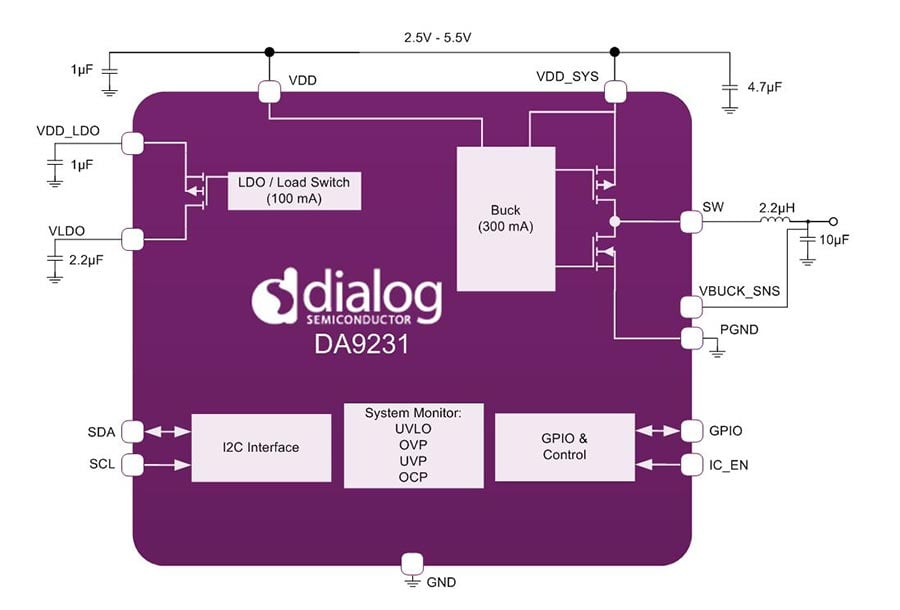
The DA9231 is an ultra-low quiescent current high-efficiency buck regulator and an ultra-low quiescent current LDO in a compact I2C configurable WLCSP package targeting battery-powered applications needing highly efficient power supplies.
The buck regulator extends high light-load efficiency down to 10μA further extending battery life. Dynamic Voltage Control (DVC) in the buck regulator facilitates optimization across the system power modes enabling further improvement in system efficiency and battery life.
The low quiescent current LDO can be configured as a load switch and provides the second supply output. The LDO's uncommitted inputs can be connected to either the battery or the buck output. Connecting the input to the buck output provides the flexibility to improve the PSRR at the LDO output as needed. It provides multiple protection features and comes with the ability to monitor the events and indicators in the GPO pin.
Benefits
- Longer battery life
- Design flexibility through configurability
- Small solution size
- Future-proofing for new technology MCUs with 0.6V min buck output voltage
- Future-proofing for new technology batteries with 2.5V min input voltage
