
| CAD Model: | View CAD Model |
| Pkg. Type: | 24 WLCSP |
| Pkg. Code: | |
| Lead Count (#): | 24 |
| Pkg. Dimensions (mm): | |
| Pitch (mm): | 0.4 |
| Moisture Sensitivity Level (MSL) | 1 |
| Pb (Lead) Free | Yes |
| ECCN (US) | EAR99 |
| HTS (US) | 8542.39.0090 |
| Lead Count (#) | 24 |
| Carrier Type | Tape & Reel |
| Moisture Sensitivity Level (MSL) | 1 |
| Pb (Lead) Free | Yes |
| Temp. Range (°C) | -40 to +85°C |
| Country of Assembly | TAIWAN |
| Country of Wafer Fabrication | TAIWAN |
| Additional Features | Programmable GPIOs |
| Battery Interface | No |
| Bus Voltage (Max) (V) | 5.5 |
| Comm. Interface | I2C |
| Function | 1-ch PMIC |
| GPIOs (#) | 5 |
| Input Voltage (Max) (V) | 5.5 |
| Input Voltage (Min) (V) | 2.5 |
| Input Voltage Range (V) | 2.5 - 5.5 |
| Integrated Battery Charger | No |
| Integrated step-down DC/DC Converter Channels (#) | 1 |
| Linear Output | No |
| MOQ | 4500 |
| Multi-Phase Support | fixed |
| Output Current Max (A) | 10 |
| Output Voltage Range (V) | 0.3 - 1.9 |
| Outputs (#) | 1 |
| Parametric Applications | Smartphones, Infotainment, Wifi Modules |
| Parametric Category | Multi-Channel Power Management ICs (PMICs) |
| Pitch (mm) | 0.4 |
| Pkg. Type | 24 WLCSP |
| Qty. per Reel (#) | 4500 |
| Step-up DC/DC converter Channels (#) | 0 |
| Switching Frequency (MHz) | 4 - 4 |
| Switching Regulators | 1 |
| Total step-down DC/DC converter channels (#) | 1 |
| VIN Range (V) | 2.5 - 5.5 |
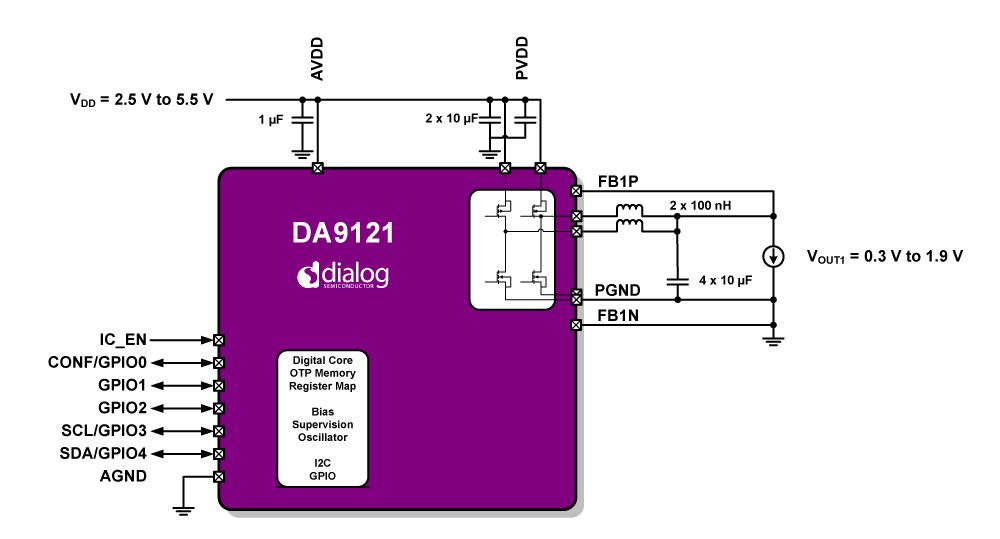
The DA9121 is a sub-PMIC suitable for supplying CPUs, GPUs, and DDR memory rails in smartphones, tablets, RF modules, and other handheld applications.
DA9121 operates as a single-channel dual-phase buck converter, each phase requiring a small external 0.10μH inductor. It is capable of delivering up to 10A of output current at a 0.3V to 1.9V output voltage range. The 2.5V to 5.5V input voltage range is suitable for a wide variety of low-voltage systems, including, but not limited to, all Li-ion battery-supplied applications.